World Scholar's Cup · 2026 · Are We There Yet?
Actually understand this year's outline — not just recognize the words.
The Cup doesn't test whether you've seen a name. It tests whether you can reason about it and connect it across subjects. Scholars Mind turns every outline point into a real lesson that explains what it means, why it matters, and how it links to the theme — then trains you for the Challenge, Bowl, Writing, and Debate.
The first section is free — no card required.
See a whole lesson — free, no account
This is one of 119 lessons, shown exactly as it appears inside. Every outline point gets this — written from scratch for this year's theme, not pulled or aggregated from another site.
More To Do Than Can Ever Be Listed
Seven Ways to Tame a List
Benjamin Franklin ran his days off a hand-ruled chart of thirteen virtues. Centuries earlier, Leonardo filled a notebook page with errands — from surveying a city to describing a woodpecker's tongue.
Key concepts
- Goal Conflict
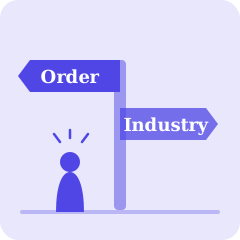
- Two goals that each look sensible can make the other impossible. Franklin's Order told him to keep a rigid daily schedule; his Industry told him to drop it the moment a client walked in, and his Frugality — mend your own clothes, cook your own meals — ate the hours both of them needed. A list usually fails here, not from laziness.
- Next Actions
- The move from an abstract goal to the specific physical step you could do next. David Allen taught the comedian Drew Carey to work from next steps rather than big ambitions, because a vague goal keeps surfacing in the back of your mind while a concrete step can actually be finished.
Every work — explained, so you never open a tab
This point names 7 to know. Instead of hunting down and reading each one, here's every one in a line:
-
Eisenhower Method (method)
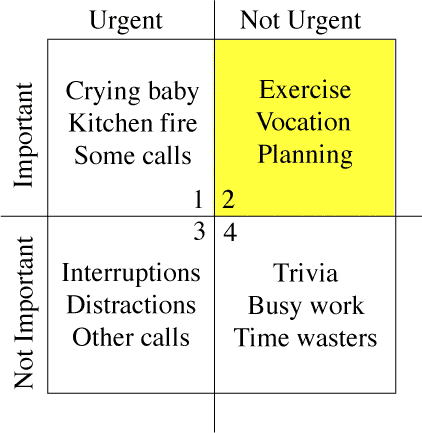
Score every task on two axes, urgent and important, then do it now, schedule it, delegate it, or delete it — from a line Eisenhower quoted in 1954 that the urgent and the important are rarely the same thing, which Stephen Covey later drew as a four-box grid.
-
1-2-3 Method (method)
Three tasks a day, picked before the day starts — usually one large and two small — so the cap itself forces you to say out loud what gets left off.
-
Ivy Lee Method (method)
In 1918 the publicist Ivy Lee told Bethlehem Steel's executives to write tomorrow's six most important tasks in priority order and work them strictly one at a time; Charles Schwab reportedly paid $25,000 for the advice.
-
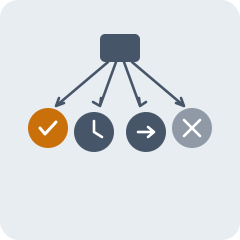
4-D Method (method)
Every task gets one of four verbs the moment it reaches you — Do it if it is quick, Defer it to a specific time, Delegate it, or Delete it — and the fourth is the one almost nobody can perform.
-
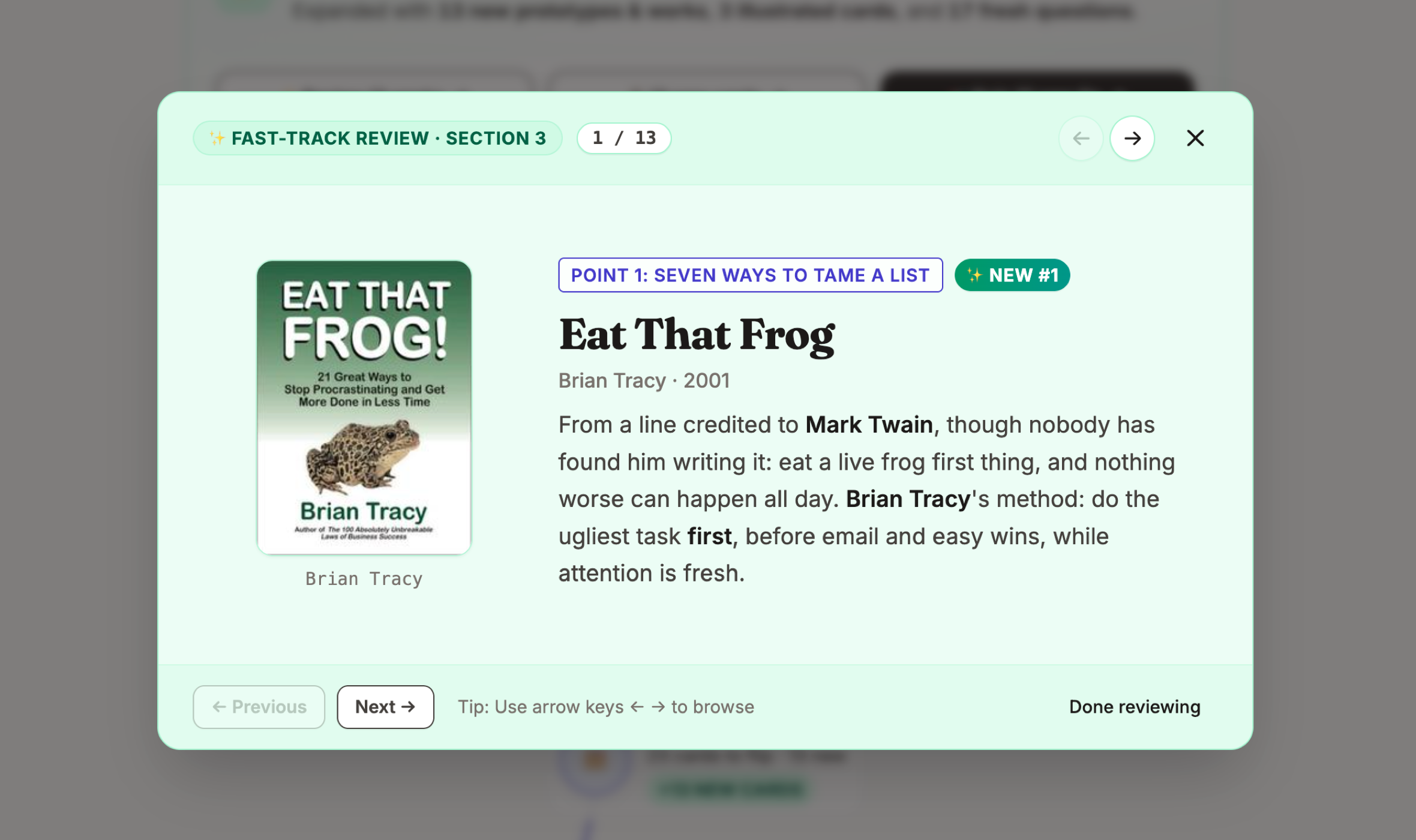
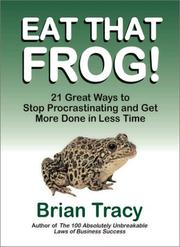
Eat That Frog — Brian Tracy (method)
Do the ugliest, most postponed task first, from a line usually credited to Mark Twain that if you eat a live frog each morning nothing worse can happen all day; Brian Tracy's 1993 book turned the quip into a method.
-
Must-Do (method)
Name only the one to three things that are genuinely non-negotiable today and demote everything else to optional, so the day becomes pass or fail instead of an open tab.
-
Bullet Journal — Ryder Carroll (method)
An analog notebook system of rapid symbols — a dot for a task, a circle for an event — with a monthly migration in which unfinished items must be re-copied by hand, so anything not worth re-writing quietly exposes itself.
Across subjects
That's one point. There are 119 more like it.
How it works
Read the lesson
Each lesson gets its own page: a vivid hook, key concepts, the specific works, and a theme tie-in — no jumping across a dozen tabs.
Practice with feedback
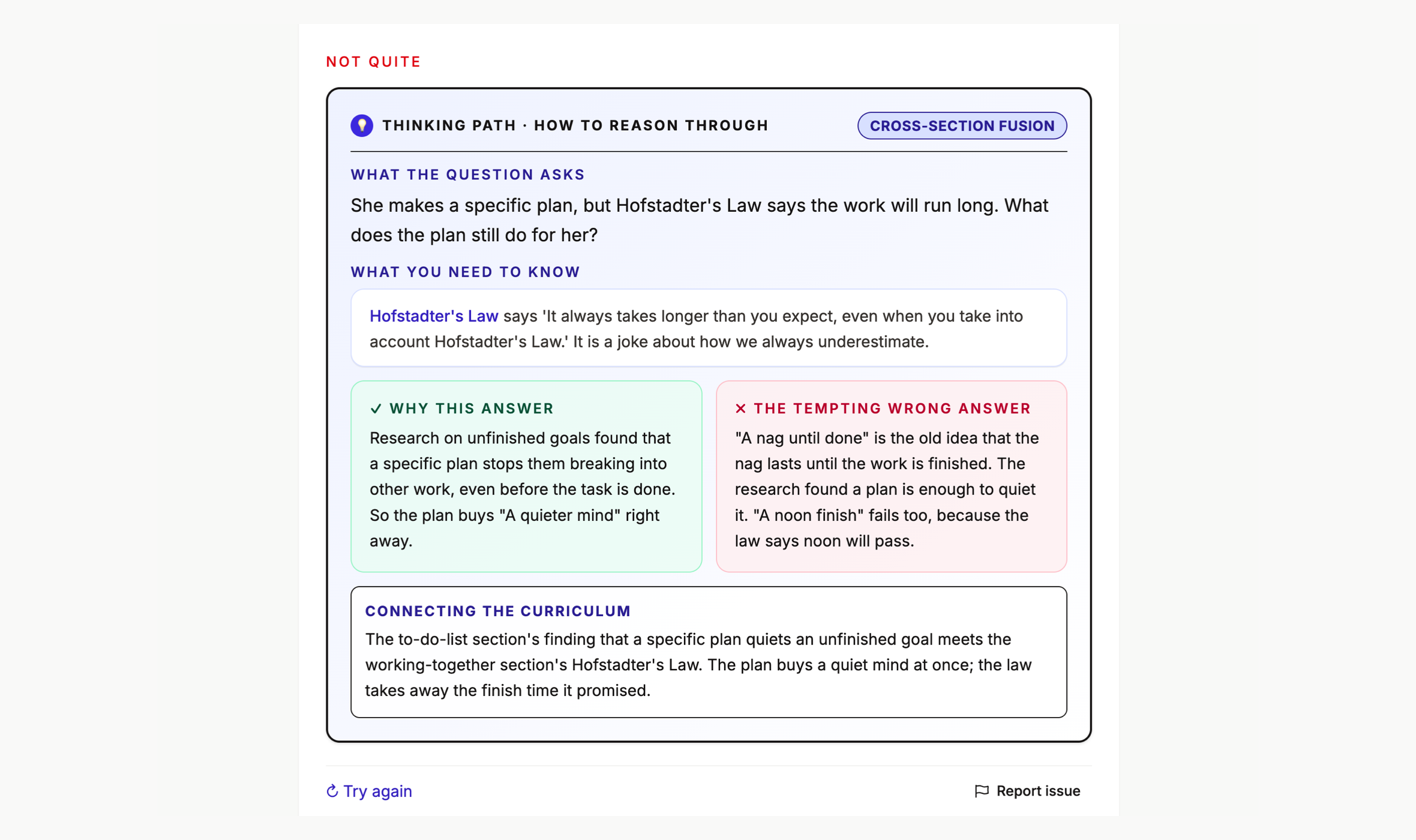
Every question is written from the lesson — not copied from another site — and every option explains why it's right or wrong, so you learn the idea, not just the answer.
Lock it in with review
Every question you answer feeds a spaced-review queue — spaced repetition, the same idea behind apps like Anki — that brings each idea back right before you'd forget, and counts down to your competition date.
Then compete, the way the Cup does
Every World Scholar's Cup event has its own trainer — built to the real rules. Try Writing, Debate, and the Bowl free — one full run each.
Scholar's Challenge →
A timed exam across all six subjects, scored with the real 1-to-n confidence mechanic — so you practice the strategy, not just the recall.
Scholar's Bowl →1 free run
Media-led rapid-fire rounds — 100 image, audio, and video questions — that escalate and stay on the clock, just like the live team event.
Writing →1 free run
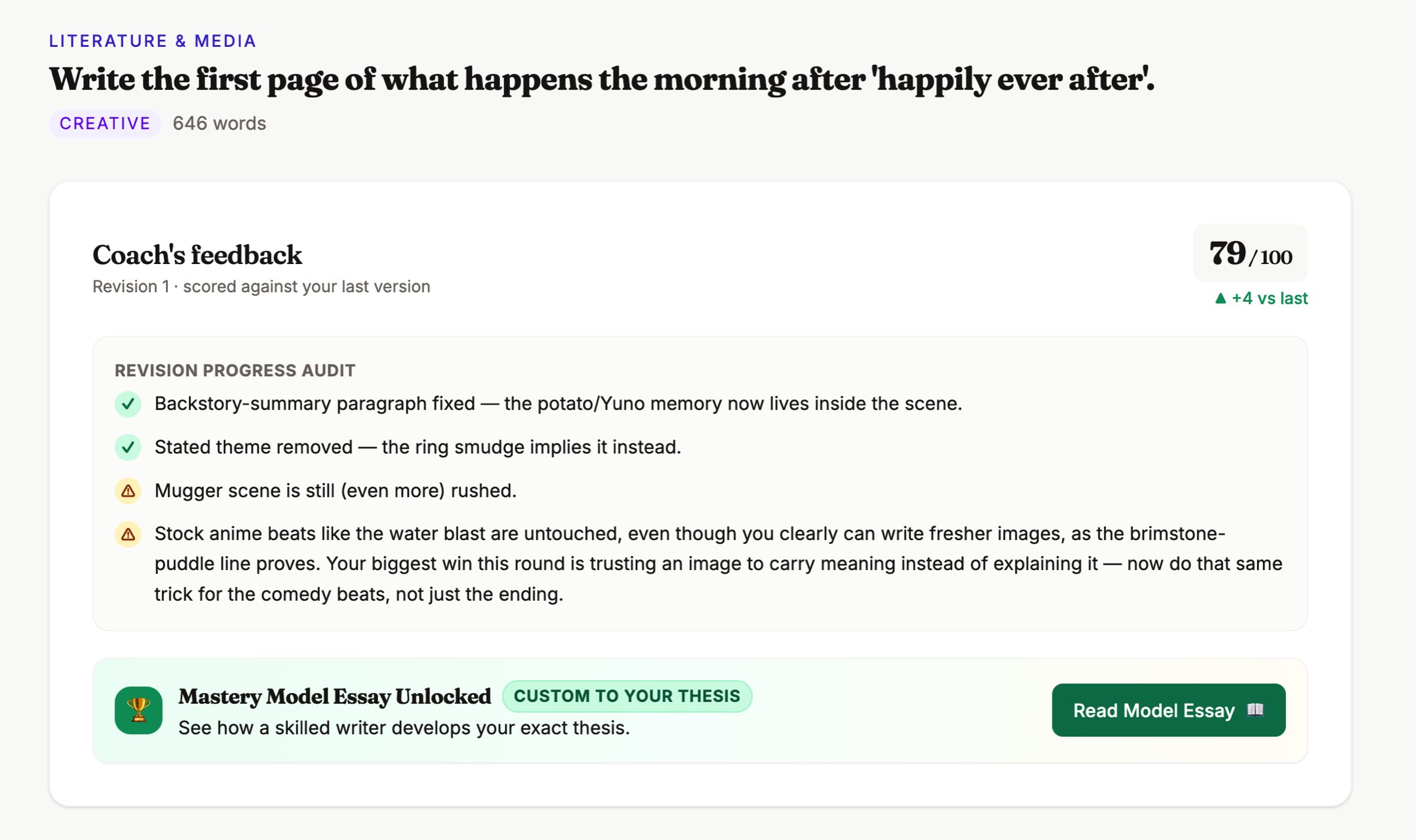
Write to a real WSC prompt and get feedback on every rubric criterion, plus a modeled rewrite that shows what stronger looks like.
Debate →1 free run
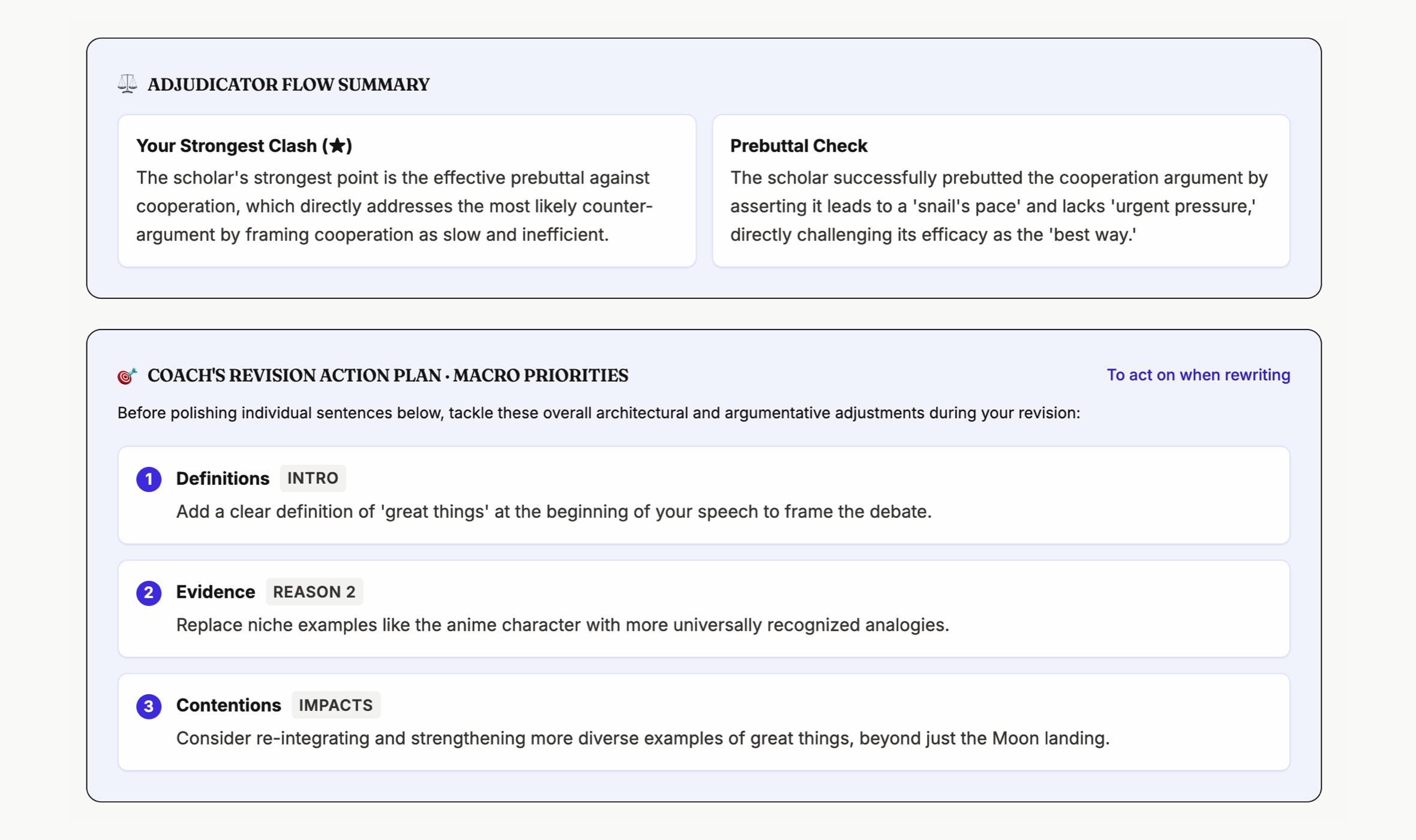
Get assigned a side, build your case against an AI opponent, then rebut — graded on the official WSC Presentation / Strategy / Content rubric.
Writing and Debate get feedback graded on your actual essay or case — not just a rubric to self-check against.
"There's free WSC material everywhere — why pay?"
Fair question. Free outlines and flashcards give you the facts. But the facts aren't the hard part of the Cup — the hard part is understanding them well enough to reason and connect under time pressure. That's the gap we close, in three ways free resources don't:
Depth you can reason from
Not a list of names — the meaning, the tensions, and the cross-subject links the Challenge and Debate actually reward.
Feedback on your work
Real grading on the essay and debate case you write. That costs money to run every time — free projects can't offer it.
A path through all of it
119 lessons is a lot. We sequence them, track what you've mastered, and resurface it before you forget — so you actually finish.
1233 questions and growing throughout the season.
Simple pricing
Start on the free section. Unlock everything when you're ready.
One season pass covers all six subjects and all four events — a fraction of the monthly cost of outside coaching.
Season Pass
$29.99 once
Full access through the 2026 season.
Monthly
$9.99 / month
Cancel anytime.