Section 3 · Point 3
Practical and Poetic Lists
“The list is the origin of culture,” the writer Umberto Eco once said. He held an exhibit of lists at the Louvre (which should have improved security on its own to-do list); he compiled a book on the topic, too. Learn about Eco’s distinction between practical and poetic lists and consider—what kind of list is a to-do list? Then discuss with your team: are we more drawn to lists than we should be?
Key concepts
A finite, useful list that stands for real things and exists to be completed: a packing list, a class register, a library catalogue. Nobody wants a class register that hints at infinity, or a catalogue promising books the library does not hold.
An open-ended list whose point is size rather than information: it names and names until you feel a vastness it never claims to cover. Walt Whitman's long lists of American workers and trades work this way. The list feels as if it could go on forever, and that is the point.
Works

Umberto Eco
1932–2016
The Italian novelist (The Name of the Rose) who, invited to curate at the Louvre in 2009, chose lists as his subject. His book The Infinity of Lists says 'the list is the origin of culture'. He split the practical list, made to be finished, from the poetic list, which was never meant to end.
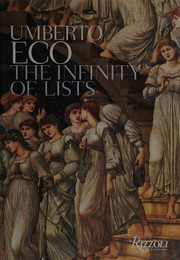
The Infinity of Lists
Umberto Eco · 2009
Umberto Eco praises the list, starting from the passage readers skip: Homer's 350-line Catalogue of Ships. He splits the practical list (shopping, guests), finite and real, from the poetic list, which points at something too vast to name. A to-do list is the humble practical cousin.
The Catalogue of Ships ✨ NEW
Homer, the Iliad
In Book 2 of the Iliad, Homer stops the war to list the Greek forces for about 350 lines, a stretch readers skip. It is Eco's chief poetic list: its job is magnitude, not information, making an army feel countless by starting to count it. Homer says no others came, so the count is closed.

Achilles' Shield ✨ NEW
Homer, the Iliad
In the Iliad the god Hephaestus makes Achilles a shield holding the whole cosmos, from the stars to the sheep in the fields. Eco calls it 'finite form': a closed world with nothing outside and no room to add. Beside the open Catalogue of Ships, Eco prefers the boundless list.

The Painted List ✨ NEW
Umberto Eco
Eco finds the poetic list beyond words. A painted list, a still life or a massacre, implies more beyond the frame. Music too: Ravel's Boléro repeats one melody, only growing louder, and could go on for ever. Sculpture defeats him: a statue cannot say 'et cetera'.

The List of Kings ✨ NEW
The worry about Eco's love of lists: lists also order, control and exclude. Many scholars see them as a by-product of writing. Only when a culture can list its kings can it fix one view of its history. The lists of places Eco loves in James Joyce also built imperial control.

The Sumerian Tablets
c. 3200 BC
Eco's claim is almost literally true. The oldest writing found is not poetry or law: the earliest Sumerian clay tablets are inventories of oil, cattle and grain. Many scholars think writing was invented to keep accounts, so people wrote lists before stories.
How it reads together
- 01 What kind of list is a to-do list? By Eco's own test, practical: finite, instrumental, pointing at real errands you can cross off. It behaves like the other kind anyway, because it regenerates — finish today's and tomorrow's is already forming — so you spend your life trying to complete something built never to end, and read the impossibility as a personal failing.
- 02 Eco's reviewer catches the distinction leaking. Homer says plainly that no other ships came, so his supposedly infinite roll-call is finite too; and elsewhere enumeration does the opposite of gesturing at vastness — a culture that can list its kings has fixed its own history, and an inventory of territories is how an empire holds them. Listing can open a horizon or close one, depending on who holds the pen.
Across subjects
History makes the claim almost literal. The oldest writing anyone has dug up is not poetry or law but inventory — Sumerian clay tablets from around 3200 BC counting jars of oil, cattle, and grain — and many scholars think writing was invented to keep accounts. People wrote lists before they wrote stories.
Theme angle
One list promises an end; the other was built to have none. Are we too drawn to them? On one side, listing is how a chaotic world becomes graspable — it made writing, museums and history possible. On the other, a list is the cheapest imitation of progress: writing 'revise Social Studies' scratches the same itch as revising.